You're not losing your mind.
You're in perimenopause.
And almost nobody told you
what it actually looks like.
The rage. The 3am wake-ups. The brain fog. The weight that won't move.
It's not in your head. It has a name. And there's a structured way through it.
"You used to be the steady one. The one who handled things. The one who didn't lose it over a dishwasher."
A 5-week self-study guide written by a woman who spent 3 years figuring this out — so you don't have to. Includes the language to bring into your next appointment, so your provider can actually help.
It will not fix everything. But it will give you your pause button back.
Not ready yet? Get the free 3am Protocol first →
"It took me WAY too long to connect the dots because nobody really talks about this stuff until you're in it. The brain fog was absolutely wild. I started keeping notes on my phone for literally everything because I couldn't trust my own brain. I thought I was developing early onset dementia."
🎧 The Click Moment
4 minutes that will give a name
to everything you've been feeling
Hear it from Sarah — physicist, researcher, and author. In under four minutes you'll understand the exact biological mechanism behind your symptoms. Thousands of women describe this as "the most clarifying thing that's ever happened to me."
After listening → Get the full 5-week protocol — $37
You're not imagining it
These aren't anxiety symptoms.
This is what perimenopause actually looks like.
The Rage That Comes From Nowhere
"The sudden RAGE. I'm generally a content and peaceful person. I meditate. But all of a sudden I got so ragey. Everything and everyone was setting me off."
#1 most-reported symptom in women 40–55Brain Fog That Scares You
"There's a giant invisible ball of cotton, 3 feet wide, duct taped around your head. Everything feels insulated, dull." — the most-shared description of perimenopause brain fog we've seen.
Most-shared description among women in their 40s"Your labs are normal" — but you're not
"My fifth OB-GYN told me to see a psychiatrist. I literally started crying in her office because I felt so exhausted and hopeless." Many women report being told their bloodwork looks fine while their daily life falls apart.
Reported by women across dozens of health communitiesThe Intimacy Nobody Warns You About
"Painful sex. Dryness that came out of nowhere. A libido that just… vanished. I thought my marriage was the problem. It wasn't." A widely reported but rarely-discussed perimenopause symptom — and one that often disappears from medical conversations entirely.
Frequently raised in community threadsWake up at 3am?
Here's exactly why — and how to stop it.
The 3am Wake-Up Protocol is a free PDF that explains the cortisol-progesterone mechanism behind perimenopausal sleep disruption — and gives you a same-night protocol to interrupt it and get back to sleep faster.
"I thought I just had anxiety. Turns out I had a progesterone problem. Once I understood the mechanism, the 3am wake-up stopped being a terrifying mystery — it became something I could actually manage."
We give this away because we believe in earning your trust before asking for your money. Experience the quality of what we create — at zero cost — and then decide whether the full 5-week guide is worth $37.
By submitting you agree to our Privacy Policy. We will use your email to send you the free PDF and occasional related updates. Unsubscribe at any time.
On its way!
Check your inbox — the 3am Protocol is heading to you now. Use it tonight.
When you're ready for the full picture, the 5-week guide is right here.
Same-night protocol + 4-week sleep repair plan.
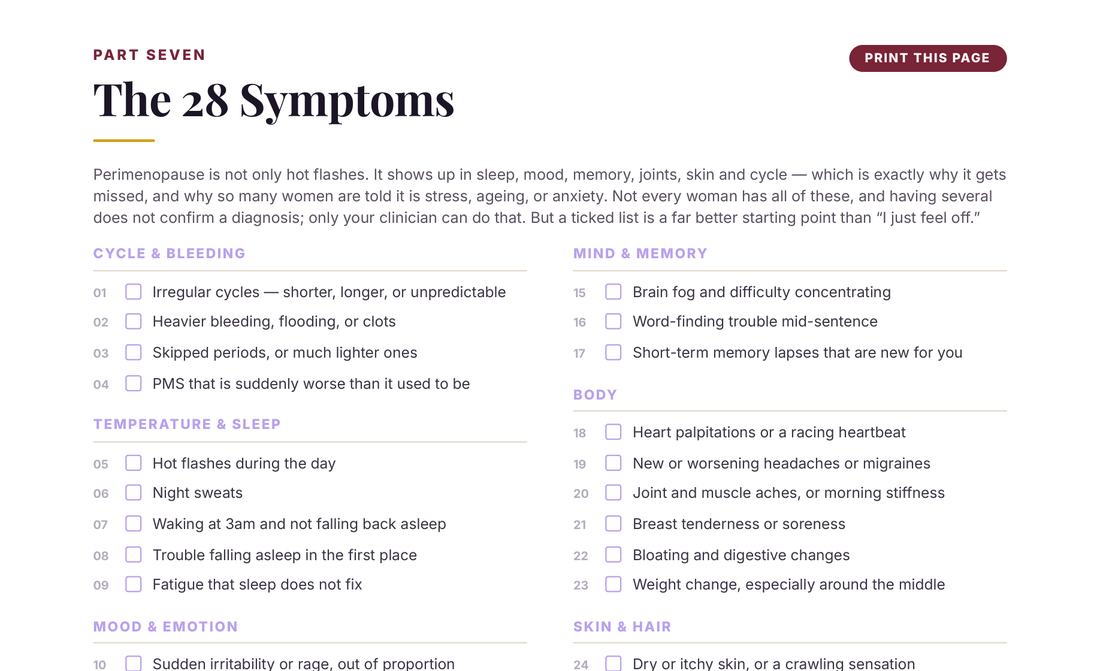
Check what applies to you
How many of these sound familiar?
Tick every box that applies — then read what it means.
You've checked 0 of 8
What you're experiencing has a name, a mechanism, and a well-documented pattern.
You are not imagining it. You are not falling apart. You are a woman in a real biological transition — and once you understand the system underneath these symptoms, you can start addressing the cause, not just managing each symptom one at a time.
Why words matter
You have real symptoms.
You deserve a real conversation about them.
Perimenopause is a documented medical transition with documented treatment options — but it's also a transition that has been historically under-discussed in medical training. Research published in peer-reviewed journals has reported that only a minority of OB-GYN residents feel adequately prepared to manage menopause, and that many women consult several different providers before receiving a perimenopause-focused evaluation.
The good news: the information exists, the treatments exist, and the providers who specialize in this exist. What's often missing is the right language to bring into the appointment — a way to describe your symptoms with the precision that allows a trained provider to do their best work.
- You don't need to convince anyone you're suffering.
- You don't need to memorize every symptom you've had this month.
- You don't need to argue about whether perimenopause is real.
- You need a clear, calm, evidence-informed way to describe what you're experiencing.
- And you need to know what to ask for, by name.
This is exactly what the guide gives you. You are not crazy. You are not becoming someone else. You are a woman in a real biological transition — and once you can describe it in the language of clinical care, the right help becomes a great deal more accessible.
Real women. Real words.
You're not the only one.
Thousands of women are figuring this out together.
"Never even heard the word perimenopause until a few years ago. I expected hot flashes — not all this other stuff."
"The brain fog was absolutely wild. Multiple times a day. I started keeping notes on my phone for literally everything because I couldn't trust my own brain anymore. I thought I was developing early onset dementia."
"I've always been the calm one in my family. The one who de-escalates. Then I found myself screaming over a dish left in the sink and I couldn't stop. I watched myself doing it and couldn't intervene."
"Five years ago I was a completely different person — unable to function, certain something was permanently wrong with me. Finding the right provider changed my life. Ladies, there is hope."
"I can't think, sleep, and barely control my emotions. It's crumbling me. I needed a clearer way to describe what was actually happening — not just a list of symptoms, but a real explanation of the pattern."
"My mother's generation suffered in silence while thinking they were going insane. We are the first generation that finally has the information to understand what's happening to us."
The 5-week protocol
What Is Actually Happening to Your Body
The biological explanation for every symptom. The progesterone drop. The estrogen rollercoaster. Why your labs look "normal." Why perimenopause can start at 35 — with regular periods.
The Nutrition Reset
Why your old approach stopped working overnight. Exact foods to cut and add to lower cortisol and stop feeding your symptoms. Full grocery list included.
The Sleep Protocol
Why so many women in perimenopause describe waking at 3am wide awake. A complete evening routine — timing, environment, and the supplement options most often discussed in the literature — built around the patterns women in this stage report.
Rage, Mood & Your Nervous System
Why the rage isn't a character flaw. Three short practical techniques widely shared in the menopause community — including the "physiological sigh" popularized in recent neuroscience media — that you can use in under two minutes when you need to ground yourself.
Movement That Works With Your Body, Not Against It
Why the high-intensity routine that worked at 30 may stop working in your 40s — and what many women shift to instead. A 3-category movement framework (strength, walking, mobility) built around what current guidelines emphasize for women in this stage.
The Healthcare Conversation
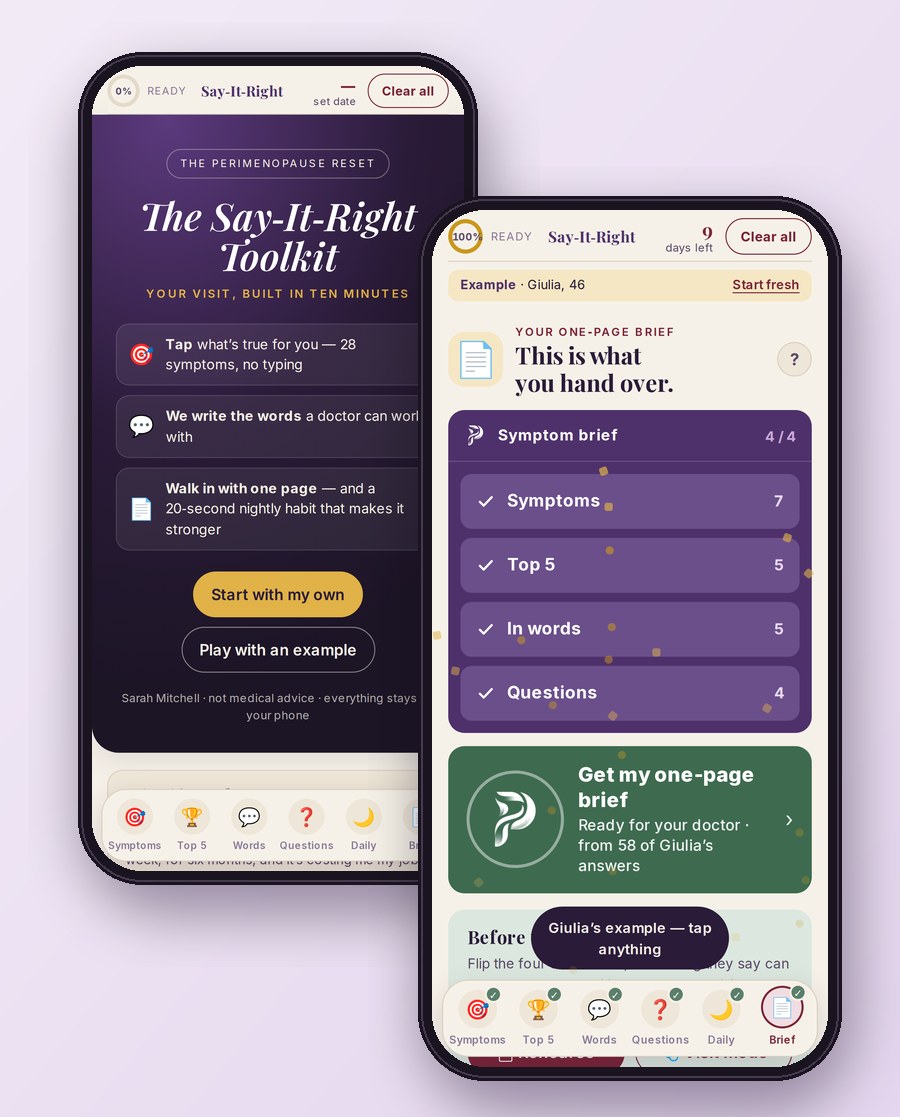
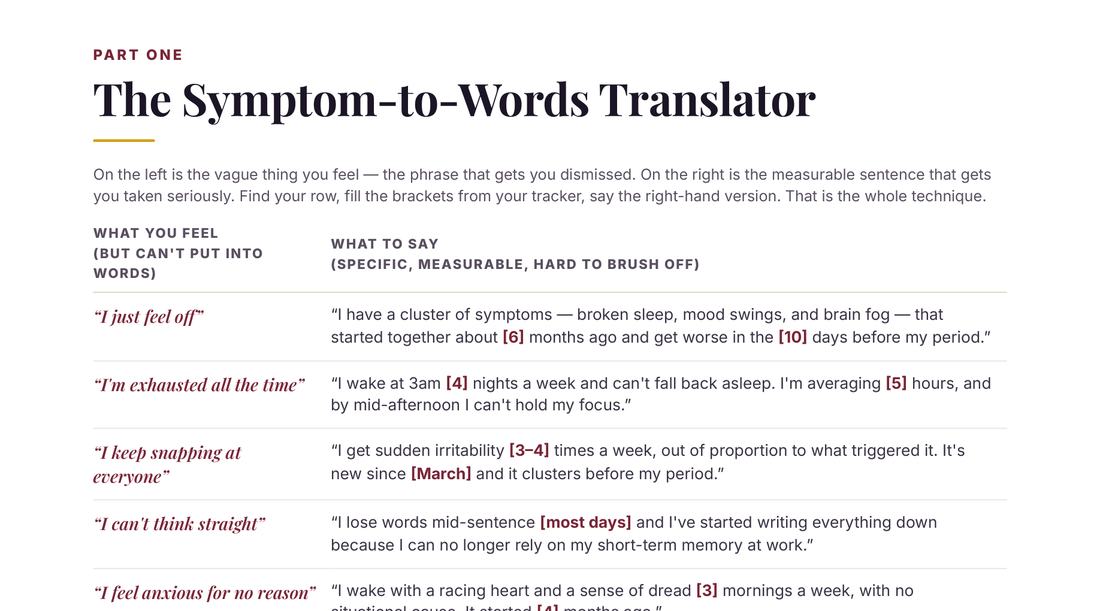
The clinical vocabulary to describe your symptoms with precision. The specific language that helps your provider connect the dots. Which symptoms to lead with. How to ask about transdermal estradiol and other evidence-based options — by name.
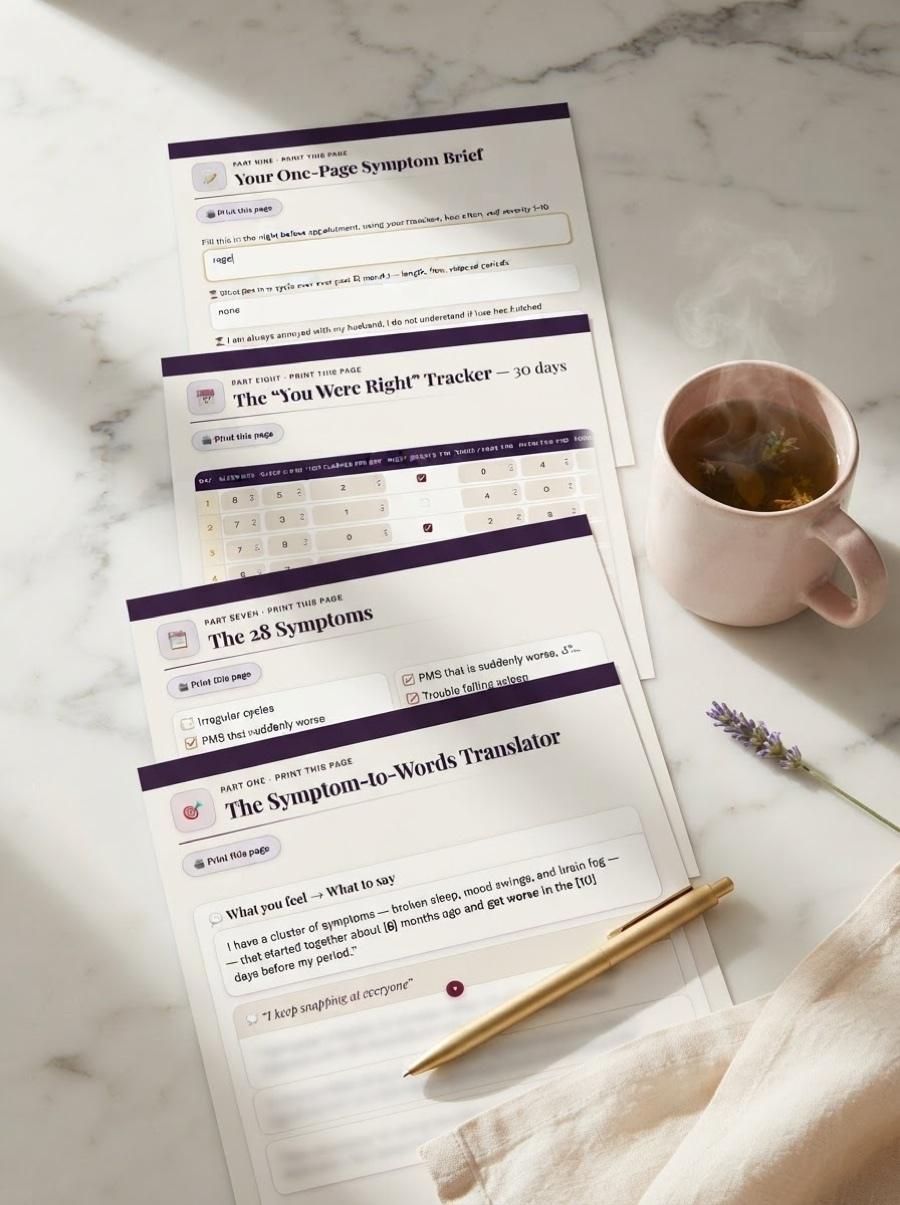
- ✓30-Day Symptom Tracker — printable, designed to bring to your healthcare appointment.
- ✓Appointment Question Checklist — 12 informed questions to bring to your provider.
- ✓Week 1 Grocery List — ready to screenshot and use.
- ✓Supplement Reference — the options most discussed in current menopause literature, with reminders to discuss with your pharmacist or provider.
- ✓Telehealth Resource List — publicly available US platforms that advertise menopause-informed care (educational reference only, no affiliation).
- ✓Glossary — 10 key terms in plain language.
Chapter 6 · The Vocabulary Builder
A clinical vocabulary,
so the experts can help you.
When you've been feeling unheard for months — or years — emotions can take over the moment you finally sit down with a healthcare provider. This chapter helps you describe what you're experiencing with the precision a clinician can act on. Not a script to perform. A vocabulary you can borrow when you need it.
Chapter 6 includes example phrasing for 5 common conversation scenarios, 12 informed questions to bring to your appointment, a complete education section on HRT and non-hormonal options, and a curated list of menopause-informed telehealth platforms.
Who wrote this
I didn't write this with credentials.
I wrote it with notebooks. Three years of them.
Hi — I'm Sarah. I'm not a physician, a nurse practitioner, or a licensed clinician of any kind. I'm a woman who, somewhere around 41, started feeling like a stranger in her own body and spent the next three years trying to understand why.
I read every accessible book on menopause I could find. I sat through appointments where I was told my labs were "normal," that I was anxious, that I should consider an antidepressant. I joined the communities where 200,000+ women compare notes because their providers won't. Slowly, the picture came into focus — not from one source, but from reading the same things over and over in peer-reviewed summaries, in NAMS guidelines, in Mayo Clinic patient education, in the lived experience of thousands of women.
This guide is the document I wish someone had handed me at 41. It's an organized summary of publicly available information, paired with the vocabulary I eventually learned to bring into a medical appointment so the conversation could actually move forward.
It is not medical advice. It is not a diagnosis. It is not a substitute for a qualified healthcare provider — it's designed to help you have a more productive conversation with one. If you want a peer who did the reading so you don't have to start from zero at 11pm on a Tuesday, this is for you.
Researcher and writer · The Perimenopause Reset · Based in the United States
Why this is different
Built for women who are done with vague advice.
| What you need | Generic blogs | Popular menopause books | Perimenopause Reset |
|---|---|---|---|
| Week-by-week action plan | ✗ | ✗ | ✓ |
| Clinical vocabulary for appointments | ✗ | ✗ | ✓ |
| Printable 30-day tracker | ✗ | ✗ | ✓ |
| Specific supplement timing | ✗ | Sometimes | ✓ |
| Written by a peer who did the research | ✗ | Sometimes | ✓ |
| Actionable in Week 1 | Maybe | ✗ | ✓ |
| Instant digital access | Scattered | Shipping | ✓ |
| Total cost | Free (your time) | $27–32 | $37 |
From the community
Women who stopped waiting for answers.
"I finally understood that the 3am wake-ups weren't ordinary insomnia — they were a hormonal pattern. Adjusting the supplement timing made a real difference for me. I've slept through the night more often than I have in months."
"I used the language from Chapter 6 at my appointment. My provider paused, looked at me and said 'you've clearly done your research.' I left feeling like I was finally part of the conversation about my own care."
"Chapter 4 on the rage finally made sense of what was happening in my brain. I'm not broken. I'm a woman going through a real, documented neurobiological shift — and now I have a framework to work with it."
Get instant access
Less than one specialist co-pay.
Designed to make every future appointment more productive.
$117 Retail Value
$37
One-time payment · Instant PDF · No subscriptions
- ✓The Perimenopause Reset — Full 5-Week Protocol (42 pages)
- ✓30-Day Printable Symptom Tracker
- ✓The Healthcare Conversation Vocabulary (Chapter 6)
- ✓12-Question Appointment Checklist
- ✓Week 1 Grocery List
- ✓Supplement Reference (general, non-prescriptive)
- ✓US Telehealth Resource List (educational)
- ✓Lifetime access + all future updates
- 🎁The 3am Wake-Up Protocol — Free bonus PDF (sleep science + same-night protocol)
Secure checkout via Stripe · PDF delivered to your inbox
30-Day Money-Back Guarantee Read the entire guide. Use the protocols for a full month. If you don't feel more informed, more equipped, and more in control — email us for a full refund. No questions asked.
Questions
Answered.
You deserve a clearer conversation.
Walk into your next appointment
with clarity, vocabulary, and a plan.
You've already spent months — maybe years — trying to make sense of what's happening in your body. This is the practical guide that helps you understand the biology, organize your symptoms, and bring the right language into the room so a qualified provider can help you most effectively.
Get The Perimenopause Reset — $37Instant PDF · 30-day guarantee · No subscriptions